
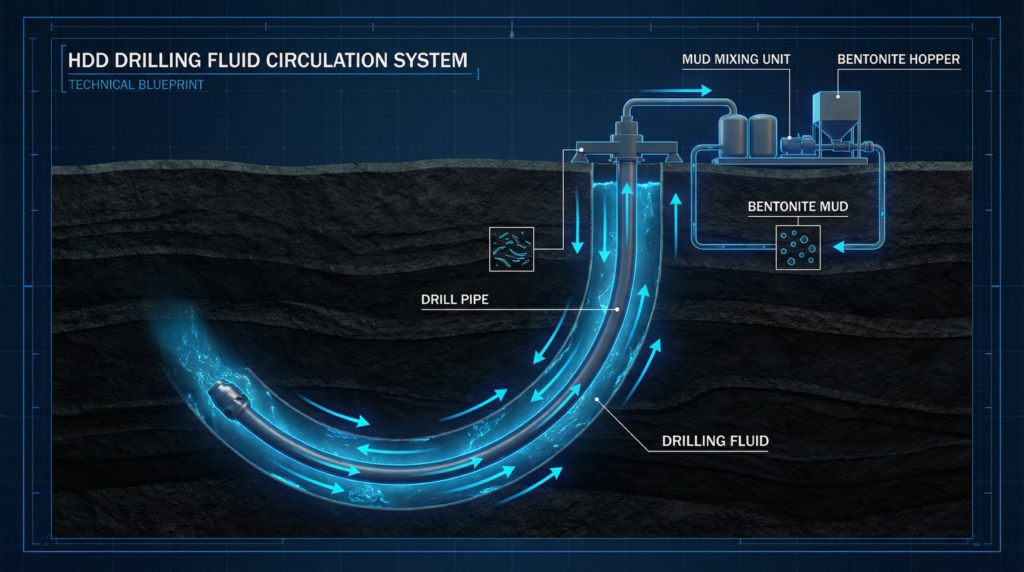
Drilling fluid — commonly called “mud” — is one of the most underestimated components of a successful HDD bore. Many contractors focus on their rig, their pipe, and their bits, but neglect the fluid system. Yet improper fluid management is responsible for a significant percentage of HDD failures, including stuck pipe, bore collapse, and inadvertent returns (frac-outs). Understanding drilling fluid is essential for every HDD operator.
What Does Drilling Fluid Do?
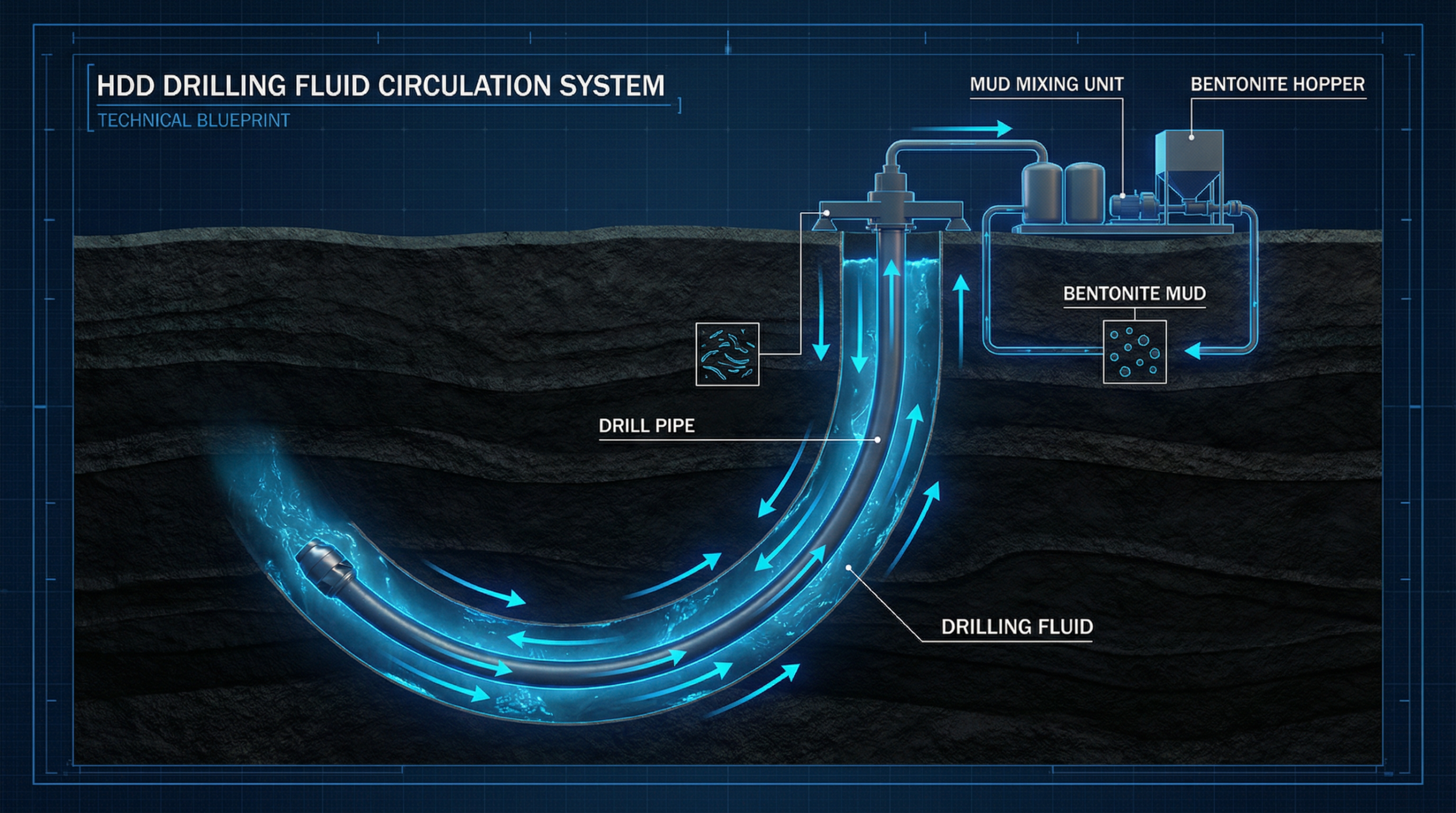
Drilling fluid performs four critical functions simultaneously during an HDD bore:
| Function | Description |
|---|---|
| Cuttings Transport | Carries soil cuttings from the cutting face back to the surface through the annular space around the drill pipe. |
| Bore Stabilization | Creates a filter cake on the bore wall that prevents collapse, especially in sandy or loose soils. |
| Lubrication | Reduces friction between the drill pipe and the bore wall, lowering pullback forces and protecting the product pipe. |
| Cooling | Cools the downhole tooling — bits, reamers, and housings — preventing premature wear from heat buildup. |
Bentonite: The Foundation of HDD Mud
The most common base material for HDD drilling fluid is bentonite, a naturally occurring clay mineral (sodium montmorillonite) that swells dramatically when mixed with water. When properly hydrated, bentonite forms a viscous, thixotropic fluid that gels when static (supporting cuttings) and flows when agitated (pumping). The standard mix ratio is typically 25–50 lbs of bentonite per 100 gallons of water, adjusted based on soil conditions.
Drilling Fluid Additives
In addition to bentonite, HDD contractors use a variety of additives to modify fluid properties for specific soil conditions. Common additives include:
- Polymer additives (e.g., PAC, PHPA): Increase viscosity and improve bore wall stability in sandy or gravelly soils.
- Clay inhibitors: Prevent reactive clays from swelling and sticking to the tooling (“clay balling”).
- Gel strengtheners: Increase the gel strength of the fluid to suspend heavier cuttings in larger bores.
- Lubricants: Reduce friction during pullback, especially for long bores or large-diameter product pipes.
The “Peanut Butter” Rule
Experienced HDD operators often describe the ideal mud consistency at the exit pit as “hot peanut butter.” If the returns are too watery, the fluid isn’t carrying cuttings effectively and the bore walls may be unstable. If the returns are too thick and chunky, the fluid isn’t flowing freely and you risk a stuck pipe. Monitoring your returns throughout the bore is one of the most important habits a good HDD operator can develop.
Elite Underground Tools stocks a full range of drilling fluid additives including bentonite, polymer additives, clay inhibitors, and lubricants. Contact us for recommendations on the right fluid system for your soil conditions.